THIS IS AN AI GENERATED DEMO IMAGE
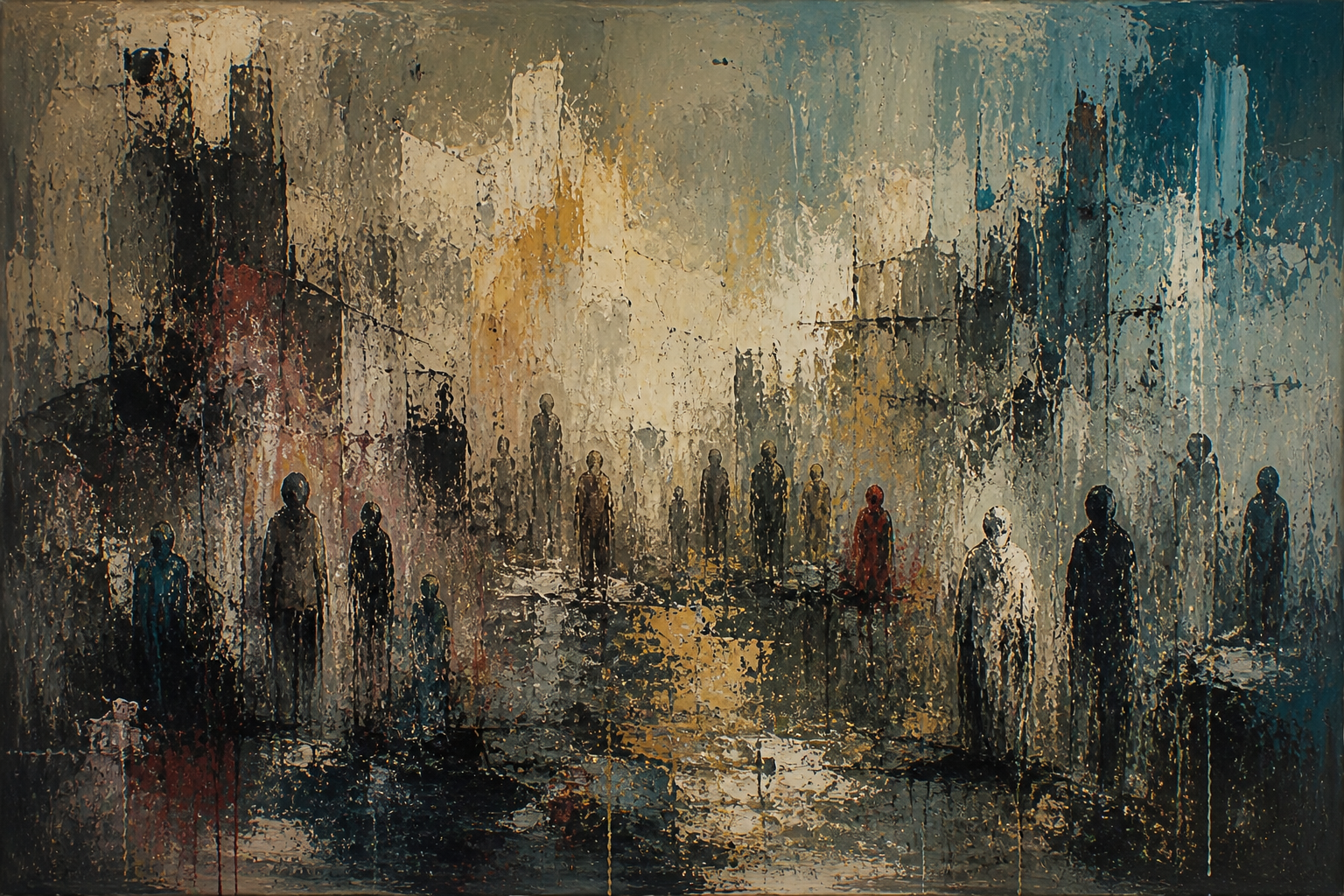
Silent Density of Absence confronts the viewer with a field of compressed presences and eroded boundaries. Across a surface built from thick, scraped layers and gestural drips, anonymous silhouettes rise and recede like figures glimpsed through rain-streaked glass. Vertical ruptures and scumbled passages organize the picture into strata: opaque masses of umber, slate and deep teal alternate with luminous bands of ochre and bleached cream, producing a sense of architecture that is at once urban and geological. Small concentrations of color—a solitary red figure, a pale white form—cut through the muted palette and insist on distinctness amid an otherwise diffused populace.
The work’s surface is its subject. Textural ridges and scraped gestures suggest both construction and decay, as if a city, a memory, or a conversation has been repeatedly inscribed and partially obliterated. Figures are deliberately non‑specific; they lack faces and identifying detail, reduced instead to vertical markers of presence. Their varying scales and intervals imply distance and disconnection: some stand in near proximity, others are isolated on the edges of the composition, and a faint horizon dissolves into atmospheric haze. Reflected light and pooling darker patches at the base evoke water or wet pavement, reinforcing an impression of transience and interruption.
As part of the Fractures collection, this painting investigates the communication gap between individuals and nations. The fractured surfaces function as metaphors for failed exchange—barriers that are simultaneous physical and psychological. Without prescribing a single narrative, the work invites careful looking, prompting questions about visibility, anonymity and the spaces that separate us. Silent Density Absence holds a tension between accumulation and absence, suggesting that what is most present in our shared environments may be precisely what we cannot fully apprehend or articulate.